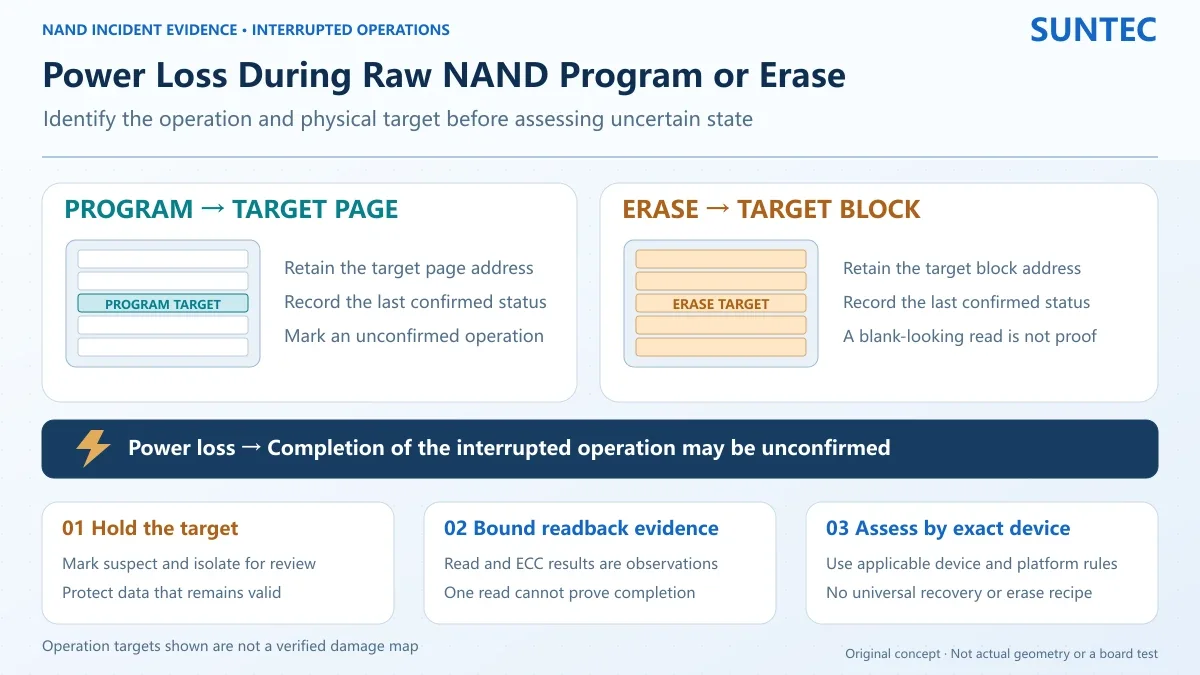
Image note: Original logical concept. Not a product photograph, physical pinout, actual parameter layout, or test result.
After NAND flash power loss during program or erase, identify the physical target and the last verified operation result. Hold an unconfirmed program page or erase block for review. A page that reads correctly after reboot may still have an unconfirmed write. A block that reads all-FF may still have an incomplete erase.
We use SLC manufacturer guidance and a bounded MLC research example to explain the evidence needed.
1. Identify the physical target and the last confirmed state
Start with the command that was in progress. Record the full part number, interface, controller, and driver version. Locate the physical block and page, plus the die, logical unit (LUN) or plane where applicable. A logical record number alone may not locate the affected array target.
If software translates addresses, preserve the mapping version associated with that command. Save the last trustworthy ready or busy observation, result status, and event order. Keep missing observations marked unknown. A status read after reboot describes the observed state then; it does not automatically reconstruct the earlier operation.
Use the NAND and SPI NAND catalogue to locate device entries. Confirm the installed part's interface against its matching manufacturer documentation. The output is one incident record linking the interrupted operation to its physical target and evidence.
2. Classify interrupted page program and block erase separately
Treat interrupted page programming and block erasure as separate cases with different physical targets. Macronix AN0340 Rev 1 dated October 21, 2014, addresses unexpected power loss in SLC NAND. It warns against accepting an unverified operation merely because the page appears correct or the block reads as all ones.
When NAND flash power loss during program happens, identify the page awaiting a verified result. When NAND flash power loss during erase happens, retain the whole target block in the unconfirmed set. This is a starting scope for investigation, not proof of the complete damage boundary.
| Recorded evidence | Initial classification | Remaining boundary |
|---|---|---|
| Completion and successful result verified before power loss | Completion established for that recorded operation | Contents and other records still need their applicable checks |
| Page program started but successful completion unverified | Target page unconfirmed | Check device rules for additional affected data |
| Block erase started but successful completion unverified | Target block unconfirmed | An all-ones read does not establish completed erasure |
Keep the completion record separate from data acceptance. Do not turn an absent failure report into a success record.
3. Use readback and ECC as supporting evidence
Preserve the available logs, mapping, and valid copies before changing the media. Collect reads through a documented diagnostic path that avoids program or erase commands. Record the read method, ECC configuration, physical range, and any known reference data.
Compare returned data with an independently retained expected record where one exists. Record mismatches and ECC results. If the reference is missing, say so. Readable bytes and a clean ECC report alone do not establish the interrupted operation's completion or future retention.
Macronix AN0363 Ver 01 dated December 17, 2014, describes SLC NAND recovery using particular management and metadata arrangements. Its unfinished-operation clues are not universal rules for every spare-area format. Do not apply an all-FF metadata test without the matching design.
For the normal command and status sequence, see our NAND read program and erase guide. Here, the output is a readback evidence set with its limits, not an automatic release decision.
4. Check whether the device requires a wider review
The command target does not always define every potentially affected record. Review the exact device's cell architecture, programming restrictions, and manufacturer guidance before narrowing the hold.
The DAC 2011 paper Understanding the Impact of Power Loss on Flash Memory reported that interrupted second-page programming could affect previously programmed first-page data on tested two-bit MLC parts. This is an architecture-dependent example. It does not mean every neighbouring page fails, or that the result applies to all SLC NAND.
List the extra locations that applicable evidence requires you to review. If the rule remains unresolved, keep the scope unresolved too. An operational hold is not a diagnosis of a permanent physical bad block. Do not write bad-block markers simply to label this incident.
5. Record what is known and what remains on hold
Build the decision from the incident record, device rules, and readback evidence. Use the following worksheet to stop observations becoming stronger conclusions than they support.
| Observation | What it supports | Next action |
|---|---|---|
| Expected data matches in a recorded range | A match under the recorded read conditions | Retain any unresolved interrupted-operation qualification |
| ECC reports an error or data mismatches | An ECC error or content mismatch was reported | Preserve evidence and follow applicable error handling |
| Target or pre-loss result cannot be reconstructed | The incident boundary remains uncertain | Escalate with the missing fields identified |
| Device-specific review requirements are satisfied | A documented decision for the reviewed scope | Record the evidence and any exclusions |
State the part, affected range, last confirmed operation, evidence gaps, and disposition. Separate an incident hold from the longer-term NAND data-retention assessment.
Raw NAND power loss recovery also needs a device and platform procedure. This article is not an erase-and-retry prescription or a report of board testing.
Handling a raw NAND power-loss incident?
Keep the full NAND part number, interrupted operation, physical target, and evidence gaps with the project requirements. Review candidate parts against the same management responsibilities and documented NAND flash power loss during program or erase conditions before changing the BOM. For a SUNTEC quotation, provide the required part number, quantity, and unresolved raw NAND power-loss recovery requirements.