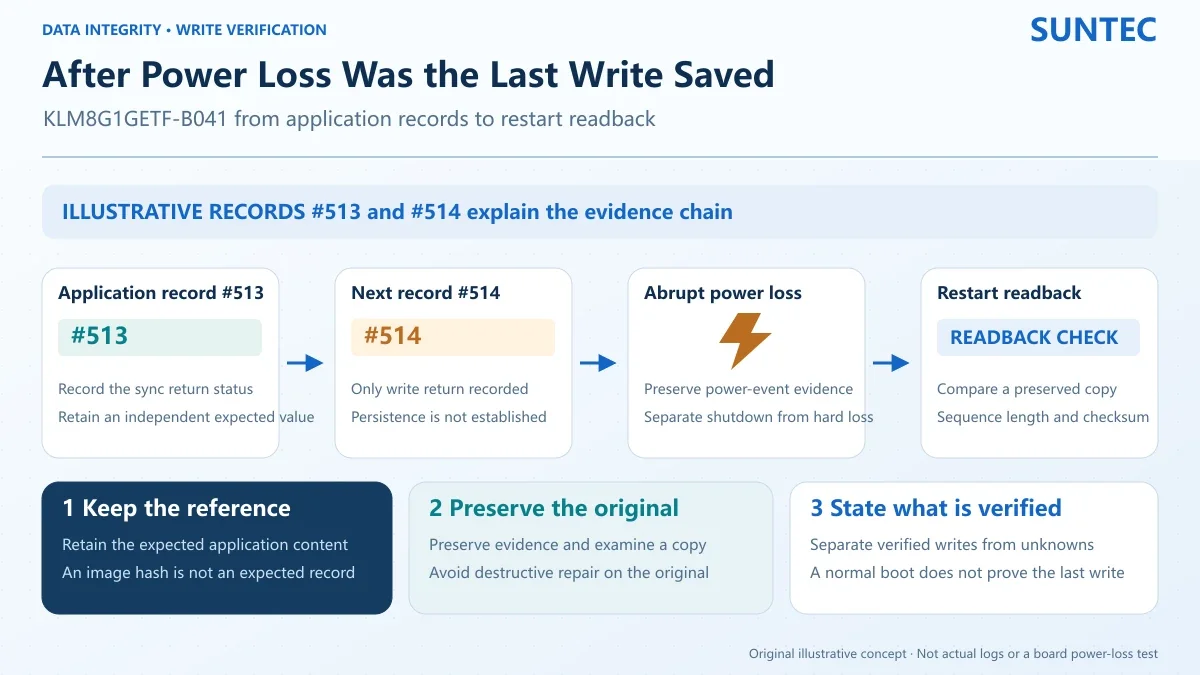
1. Preserve the incident and the original storage
Confirm the full KLM8G1GETF-B041 identifier and record the board, kernel, BSP, filesystem, mount options, and application versions. Distinguish a software shutdown, a detected undervoltage event, and an unannounced loss of power. Preserve existing console and power-event records before changing the setup.
Stop unnecessary writes to the original. Use an approved external-boot and imaging procedure, then work on copies. The ext4 documentation warns that a normal read-only mount can replay its journal and write to the partition. Using ro,noload skips replay but can expose an inconsistent filesystem. State whether you examined the crash image or a separately recovered copy. Later conclusions must identify that view.
2. Separate the write response from the synchronization response
Establish what the application actually acknowledged. write(2) explains that a successful return does not guarantee commitment to storage. Check the returned byte count as well. fsync(2) describes synchronization of file data and associated metadata, waiting for the device to report completion. If the operation created or renamed a file, also check synchronization requirements for the affected directory entries.
The write response and the synchronization response answer different questions. Do not merge them into a single "saved" event.
| Evidence | What it supports | What to retain |
|---|---|---|
| Write return value | Byte count reported by that call | Requested length and any short write or error |
| Synchronization call and return | Whether that request reported success | Exact interface and error path |
| Post-event readback | Content in the examined view | Sequence, length, and independent expected checksum |
Place those results beside the application acknowledgement on one timeline. A log entry saying "saved" needs its corresponding call and return value. If those are unavailable, retain the gap rather than assume synchronization occurred.
3. Check the actual eMMC cache flush and shutdown paths
The Linux block-layer documentation distinguishes volatile write caching, flushing, and FUA. When investigating an eMMC cache flush, check the actual BSP, driver, and device-cache configuration. Host-side write completion does not by itself establish that all data is persistent.
The upstream MMC implementation at revision c17fdf62 contains conditional cache-flush and power-off-notification paths. Its normal-shutdown and undervoltage branches differ. An eMMC power off notification depends on host and device support, with enough remaining power to complete the applicable procedure. An unannounced loss may leave no opportunity to run it. Record the path actually taken and its return status.
We have not obtained a matching public Samsung specification guaranteeing this full part number's power-loss outcome. Another platform's code cannot supply that guarantee. Our Samsung KLM selection guide covers basic selection. This step establishes implementation conditions for the incident.
4. Compare sequence numbers, lengths, and expected checksums
The following is a fictional interpretation example, not a board-test result. An independent log retains record 513's expected length, SHA-256 value, and successful synchronization response. For record 514, it retains only the write-call return. Extract each record from the examined copy and compare it with the independently retained pre-event reference.
| Observation | Supported conclusion | What remains unproven |
|---|---|---|
| 513 matches in sequence, length, and checksum | 513 is verified in this view | Integrity of records not examined |
| 514 is missing or only an earlier version remains | The latest 514 is unverified | Whether the device ever received its write |
| 514 has the expected sequence but a different checksum | Its content check failed | Which layer caused the failure |
| No independent expected content or checksum exists for 514 | That comparison cannot be completed | Correctness merely because the file opens |
A checksum of the image itself checks whether that copy changes. It cannot replace the expected checksum of the application record. We can now report 513 as the highest verified sequence among the records examined, with 514 unverified. This result does not locate the layer where information was lost.
5. Report a bounded result before planning another test
Retain the original and copy identifiers, view and tool versions, power event, last application acknowledgement, synchronization response, and readback outcome. Mark unavailable timing evidence explicitly. Long-term offline retention of already stored data is a separate task covered in our NAND retention review.
If eMMC power-loss testing is needed, plan it separately in an approved development setup with a recovery path. Use independent records to correlate the write stage, synchronization response, and actual supply changes. Keep each run's result. This workflow reports no hardware test and specifies no universal hold-up time or recovery guarantee for this part.
Checking a power-loss write case?
Keep the KLM8G1GETF-B041 part number, board and software versions, and confirmed synchronization and power conditions with the project brief. Compare candidate parts against the same persistence requirements and verification boundaries, using matching manufacturer documentation. For a SUNTEC quotation, provide the full part number, quantity, and unresolved power-loss operating conditions.